Estructura Estados Financieros
En esta sección se presentan diversos estudios relacionados con los múltiples temas que se desprenden de las Normas Internacionales de Información Financiera relacionadas con “Presentación de Informes Financieros”, documentos emitido por el International Accounting Standards Board (IASB). La presentación de los estudios se estructura en dos categorías. La primera comprende trabajos realizados por Observatorio IFRS, mientras que la segunda categoría se centra en proporcionar bibliografía de interés.
|
Normas Internacionales de Contabilidad e Información Financiera e Interpretaciones que regulan esta área de información: |
||
| IFRS 8 | : | Segmentos de Operación |
| IAS 1 | : | Presentación de Estados Financieros |
| IAS 7 | : | Estado de Flujo Efectivo |
| IAS 8 | : | Políticas Contables, Cambios en las Estimaciones Contables y Errores |
| IAS 10 | : | Hechos Ocurridos despúes del Período sobre el que se Informa |
| IAS 24 | : | Información a Revelar sobre Partes Relacionadas |
| IAS 33 | : | Ganancias por Acción |
| IAS 34 | : | Información Financiera Intermedia |
| IFRIC 10 | : | Presentación de Estados Financieros |
Estudios realizados por Observatorio IFRS:
CÓDIGO OEF - 001
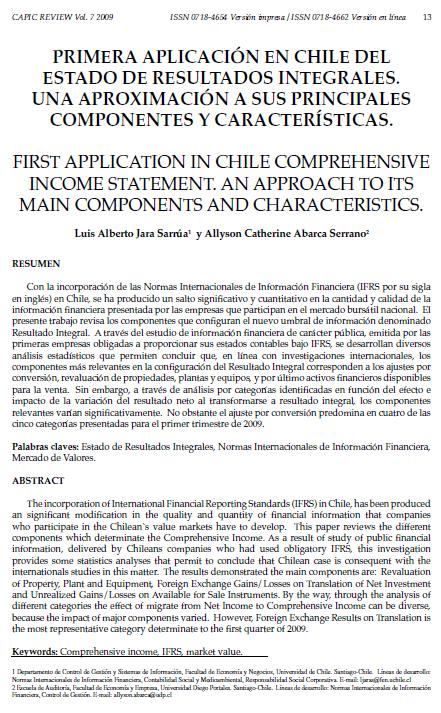
Jara, L. y Abarca, A.(2009).Primera aplicación en Chile del Estado de Resultados Integrales. Una aproximación a sus principales componentes y características. CAPIC Review, Volumen 7, pp. 13-21.
Descargar: 
Abstract
Con la incorporación de las Normas Internacionales de Información Financiera (IFRS por su sigla en inglés) en Chile, se ha producido un salto significativo y cuantitativo en la cantidad y calidad de la información financiera presentada por las empresas que participan en el mercado bursátil nacional. El presente trabajo revisa los componentes que configuran el nuevo umbral de información denominado Resultado Integral. A través del estudio de información financiera de carácter pública, emitida por las primeras empresas obligadas a proporcionar sus estados contables bajo IFRS, se desarrollan diversos análisis estadísticos que permiten concluir que, en línea con investigaciones internacionales, los componentes más relevantes en la configuración del Resultado Integral corresponden a los ajustes por conversión, revaluación de propiedades, plantas y equipos, y por último activos financieros disponibles para la venta. Sin embargo, a través de análisis por categorías identificadas en función del efecto e impacto de la variación del resultado neto al transformarse a resultado integral, los componentes relevantes varían significativamente. No obstante el ajuste por conversión predomina en cuatro de las cinco categorías presentadas para el primer trimestre de 2009.
Referencias bibliográficas de interés:
CÓDIGO: BEF - 001
Archer, S., McLeay, S, Delvaille, P. (1995). The measurement of harmonisation and the comparability of financial statement items: within-country and between-country effects. Accounting and Business Research. Volumen 25, 67-80.
Abstract
European companies with shareholders from different nations have options available in terms of accounting policy. There has been little progress toward harmonization in the European Union (EU) in the areas of consolidated goodwill and deferment of taxation. There has been less progress in compatibility within countries than there has between countries. Directives from the European Commission have been flexible in these areas. A distinction should be made between legislation and what actually happens in these areas.
Disponible en:
CÓDIGO: BEF - 002
Barth, M. (2006). Including estimates of the future in today's financial statements. BIS Working Papers No 208 Monetary and Economic Department.
Abstract
This paper explains why the question is how, not if, today’s financial statements should include estimates of the future. Including such estimates is not new, but their use is increasing. This increase results primarily because standard setters believe asset and liability measures that reflect current economic conditions and up-to-date expectations of the future will result in more useful information for making economic decisions, which is the objective of financial reporting. This is why standard setters seem focused on fair value accounting. How estimates of the future are incorporated in financial statements depends on the asset and liability measurement attribute, and on financial reporting definitions of assets and liabilities. The present definitions depend on identifying past transactions or events that give rise to expected inflows or outflows of economic benefits and, for inflows, control over the expected benefits. Thus, not all expected inflows or outflows of economic benefits are recognised. Note disclosures can help users understand recognised estimates, and can provide information about unrecognised estimates. Including more estimates of the future in today’s financial statements would result in an income measure that differs from today’s income, but arguably provides better information for making economic decisions.
Disponible en:
http://papers.ssrn.com/sol3/papers.cfm?abstract_id=947525
CÓDIGO: BEF - 003
Biddle, G y Choi, J. (2006). Is Comprehensive Income Useful?. Journal of Contemporary Accounting & Economics. Volume 2, Issue 1, pp. 1–32.
Abstract
With the International Accounting Standards Board (IASB) now considering the question, we examine 16 different definitions of income across three applications: information content, predictive ability and executive compensation contracting. Our results reveal that comprehensive income defined by FASB Statement 130 (NI130) dominates both traditional net income (NI) and fully comprehensive income (NIbroad) in explaining equity returns, but that NI dominates NI130 and NIbroad in explaining executive compensation. These findings are strikingly consistent with prior lobbying positions. In predictive ability, no definition clearly dominates. When income components are considered, NIbroad dominates in all three applications, thus lending support to the disclosure of comprehensive income components.
Disponible en:
http://www.sciencedirect.com/science/article/pii/S1815566910700151
CÓDIGO: BEF - 004
Bonsón, E. , Cortijo, V., y Escobar, T. (2009). Towards the global adoption of XBRL using International Financial Reporting Standards (IFRS). International Journal of Accounting Information Systems. Volumen 10, pp. 46–60.
Abstract
XBRL is a language based on XML for the electronic communication of business information. It is designed to improve the exchange, aggregation and analysis of corporate data requiring disclosure, through a unique tagging structure that provides interoperability. But, the proliferation of a multitude of XBRL taxonomies, based on different accounting principles, can risk the objectives of standardization, comparability and re-usability of the information that is sought with XBRL. It is therefore essential to develop global accounting standards as a unique foundation on which the XBRL taxonomies can be established, so that it becomes possible to comprare the financial information originating from various countries. Along these lines, the International Financial Reporting Standards (IFRS-GP) taxonomywas created to establish a common ground for international firms and create a platform that would enhance the benefits of XBRL. This paper examines whether the IFRS-GP taxonomy, at its current state, adequately covers European companies' dissemination practices and strengthens the benefits of XBRL. Our results provide implications for the evaluation of the effectiveness of the IFRS-GP taxonomy and shed light on directions that may lead to the improvement of this taxonomy.
Disponible en:
http://www.sciencedirect.com/science/article/pii/S1467089508000572
CÓDIGO: BEF - 005
Carmona, S. y Trombetta, M. (2008). On the global acceptance of IAS/IFRS accounting standards: The logic and implications of the principles-based system. Journal of Accounting and Public Policy. Volumen 27, Issue 6, pp. 455–461
Abstract
The widespread acceptance of International Accounting Standards (IAS)/International Financial Reporting Standards (IFRS) makes it timely to examine their technical determinants as well as their implications for the accounting profession and the process of accounting harmonization. In this respect, we suggest that the principles-based approach to the standards and its inner flexibility enables the application of IAS/IFRS to countries with diverse accounting traditions and varying institutional conditions. Furthermore, the principles-based approach involves major changes in the expertise held by accountants and, hence, in their educational background, training programs, and in the organizational and business models of accounting firms. Finally, we submit that the standards set by the IAS/IFRS constitute a step forward in the process of accounting harmonization, although there is still far to go in the comparability of accounting measures across countries and regions.
Disponible en:
http://www.sciencedirect.com/science/article/pii/S0278425408000926
CÓDIGO: BEF - 006
DeFond, M., Hub, X., Hunga, M., y Lic, S. (2011). The impact of mandatory IFRS adoption on foreign mutual fund ownership:The role of comparability. Journal of Accounting and Economics. Volume 51, Issue 3, pp. 240–258
Abstract
Proponents of IFRS argue that mandating a uniform set of accounting standards improves financial statement comparability that in turn attracts greater cross-border investment. We test this assertion by examining changes in foreign mutual fund investment in firms following mandatory IFRS adoption in the European Union in 2005. We measure improved comparability as a credible increase in uniformity, defined as a large increase in the number of industry peers using the same accounting standards in countries with credible implementation. Consistent with this assertion, we find that foreign mutual fund ownership increases when mandatory IFRS adoption leads to improved comparability.
Disponible en:
http://www.sciencedirect.com/science/article/pii/S0165410111000188
CÓDIGO: BEF - 007
Maines, L. y McDaniel, L. (2000). Effects of Comprehensive-Income Characteristics on Nonprofessional Investors' Judgments: The Role of Financial-Statement Presentation Format. The Accounting Review, Vol. 75, No. 2, pp. 179-207.
Abstract
Statement of Financial Accounting Standards (SFAS) No. 130 requires companies to report comprehensive income in a primary financial statement, but allows its presentation in either a statement of comprehensive income or a statement of stockholders' equity (Financial Accounting Standards Board [FASB] 1997). In an experiment, we examine whether and how alternative presentation formats affect nonprofessional investors' processing of comprehensive-income information, specifically, information disclosing the volatility of unrealized gains on available-for-sale marketable securities. The results show that nonprofessional investors' judgments of corporate and management performance reflect the volatility of comprehensive income only when it is presented in a statement of comprehensive income. We provide evidence consistent with our psychology-based framework that these findings occur because format affects how nonprofessional investors weight comprehensive-income information and not whether they acquire this information or how they evaluate it.
Disponible en:
http://www.jstor.org/stable/info/248644
CÓDIGO: BEF - 008
Van Cauwenberge, P. y De Beelde, I. (2007). On the IASB comprehensive income project: an analysis of the case for dual income display. Abacus. Volumen 43, Issue 1, pp.1–26.
Abstract
The IASB is presently involved in a project on reporting comprehensive income. Since the IASB accounting model mixes two income determination systems, namely, historical cost accounting and fair value accounting, an interesting question pertains to whether the display of comprehensive income should reflect the existence of these two paradigms. This article scrutinizes, from both the points of view of accounting theory and a valuation perspective, the typical arguments made by proponents of historical cost net income and comprehensive fair value income. It finds that claims for exclusive reliance on a single concept of income are untenable. The analysis provides arguments in defence of an income display that explicitly features both income concepts. Such a dual income display would correspond to a categorization of comprehensive income that is currently investigated in the IASB performance reporting project. However, given the importance of summarization in financial analysis, as is most extremely reflected in the focus on the earnings per share (EPS) number, the case for a dual income display should also be considered at the highest level of summarization of financial performance reporting. In other words, mandatory publication of two EPS numbers, one for net income, and one for comprehensive income, should be considered. Possible effects on perception and actual use of financial reports that should enter such a consideration are suggested as topics for experimental research.
Disponible en:
http://onlinelibrary.wiley.com/doi/10.1111/j.1467-6281.2007.00215.x/full